


Nov 03, 2026
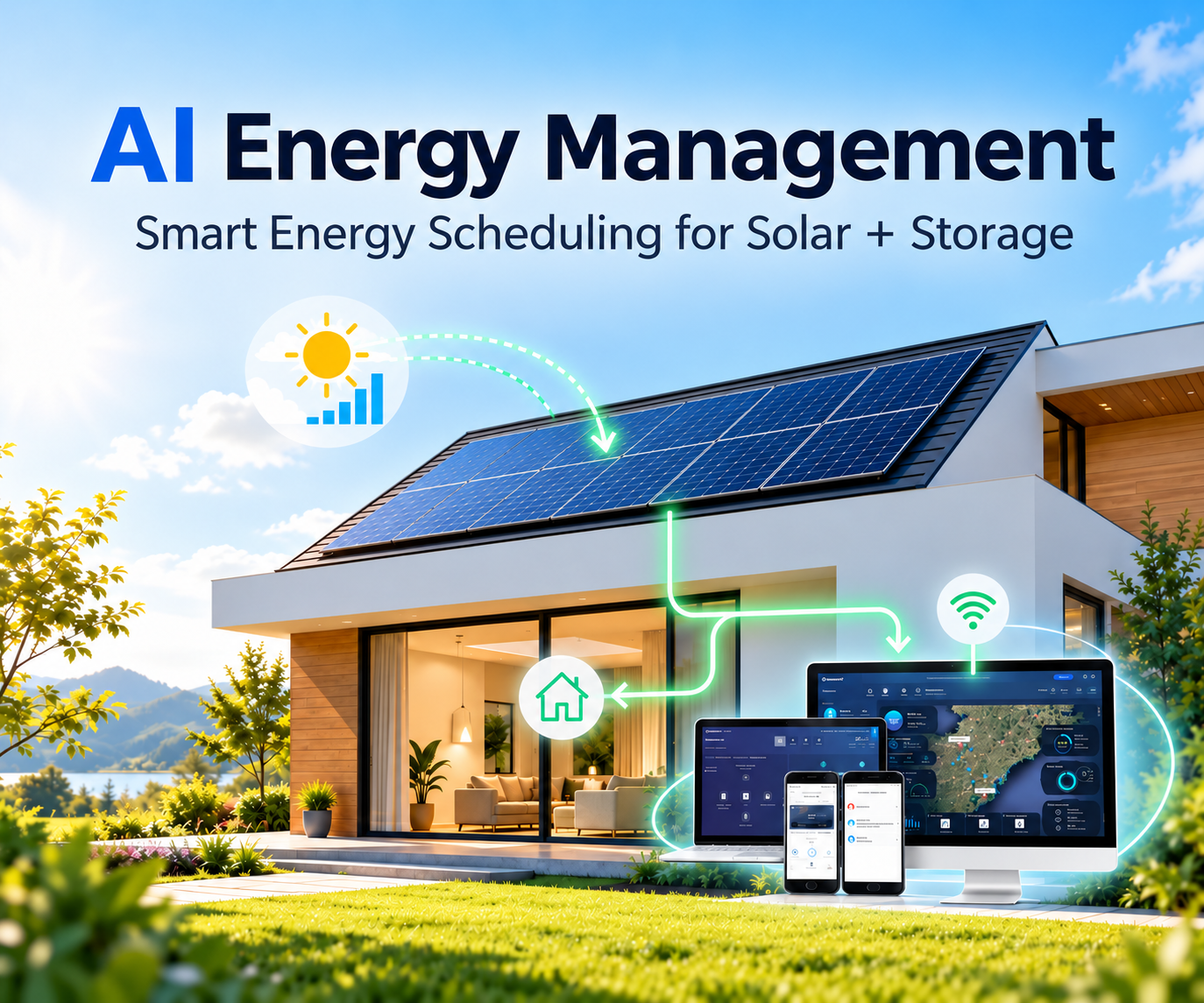
As solar and battery systems connect, artificial intelligence (AI) can optimize how electricity is generated, stored and consumed. It uses solar forecasts, demand, battery state of charge (SOC), tariffs and historical patterns to guide decisions. The IEA’s September 2026 report, Modernising Grids in the Age of Electricity, identifies forecasting and optimization as important for grid flexibility and renewable integration.
An AI energy management system (AI EMS) uses data, forecasting and optimization algorithms to manage generation, consumption, storage and grid interaction. Unlike fixed schedules, it can consider expected solar output, demand, prices, battery SOC and user preferences when scheduling charging or discharging.
Solar Forecast + Load Forecast + Battery SOC + Tariffs + User Preferences = Optimized Energy Schedule
Depending on configuration, energy management may coordinate solar panels, hybrid inverters, batteries, EV chargers, smart appliances and grid connections.
AI energy management generally relies on solar generation forecasting, electricity load forecasting, battery SOC monitoring and tariff optimization.
Solar Generation Forecasting: Predicting Future Solar Energy Production
Solar output varies with weather, cloud cover, temperature and season. Forecasting combines historical production with weather data to estimate future generation. If strong solar output is expected, the system may leave battery capacity for surplus solar; if cloudy weather and low overnight prices are expected, grid charging may be considered. Decisions depend on tariffs, settings, battery limits and user preferences.
Electricity Load Forecasting: Understanding When Energy Will Be Needed
AI load forecasting uses historical consumption to identify household or commercial demand patterns. Homes may use more power when people return, cook, use air conditioning or charge EVs; commercial demand follows operating hours, while industrial demand may track production. Forecasting helps estimate future battery needs, such as preserving energy for evening use.
Battery SOC Optimization: Making Better Use of Stored Energy
Battery state of charge (SOC) indicates remaining energy relative to usable capacity. AI-assisted systems can consider SOC, solar forecasts, demand, backup reserves and tariffs. They may preserve energy for high-price periods or maintain a minimum backup reserve, balancing cost goals with battery limits and user preferences.
Dynamic Electricity Tariff Optimization: Choosing When to Buy or Store Electricity
Fixed tariffs are stable, time-of-use tariffs define peak/off-peak periods, and dynamic tariffs vary with market conditions. Tariff-aware management can help decide when to import, charge, use solar or limit exports. Growatt’s Negative Tariff Mode for applicable Netherlands systems adjusts inverter export behaviour during negative-price periods. Its AI Smart Schedule Mode incorporates load forecasts, tariff information and battery charging/discharging strategies. Availability depends on system, market and configuration.
Traditional fixed TOU scheduling charges or discharges at preset times and repeats a schedule. It does not inherently forecast solar generation or consumption, but can suit predictable tariffs.
AI smart scheduling can use dynamic prices, solar forecasts and historical consumption to adapt schedules where supported. A fixed overnight grid-charging schedule may miss tomorrow’s solar surplus; AI scheduling can consider that forecast.
Example: A home has rooftop solar, a hybrid inverter and a 10 kWh usable battery on a time-of-use tariff. At 7 AM, SOC is 30%; strong afternoon solar and higher prices from 6–10 PM are forecast. The system may use solar in the morning, charge from midday surplus, preserve energy for evening peaks and reassess overnight grid charging using the next day’s forecast.
This may increase solar self-consumption and reduce peak-period imports, but savings depend on system capacity, efficiency, tariffs, local rules and household use.
Commercial and industrial (C&I) sites may face high demand, demand charges, export limits and backup needs. Depending on capability, energy management coordinates solar PV, batteries, grid imports and facility consumption. Strategies include peak shaving, peak-valley arbitrage, solar self-consumption optimization and demand flexibility. The IEA notes demand response can improve grid flexibility but remains underused.
Growatt’s ecosystem includes solar inverters, hybrid storage, monitoring platforms, energy managers and connected technologies such as AI Smart Schedule Mode, GroHome, GroHomeManager-X, ShinePhone and SEM-XA-R. Their roles differ: predictive scheduling, home coordination, measurement and communication, user monitoring, and C&I monitoring or export control are not interchangeable.
Growatt AI Smart Schedule Mode: Predictive Energy Scheduling
Growatt’s AI-powered Smart Schedule Mode uses consumption behaviour, tariff signals and battery requirements. Its published technical overview describes machine-learning load forecasting, intelligent battery charging/discharging, TOU pricing integration and app-based scheduling adjustments. Availability depends on compatible equipment and configuration.
Growatt GroHome: Intelligent Home Energy Management
GroHome connects compatible solar generation, batteries, EV chargers, heating controls, VPP interfaces and smart IoT devices. Growatt describes it as supporting generation and consumption prediction using big data and AI. Depending on devices and configuration, solar energy may be directed to batteries, EV charging or other controllable household devices.
GroHomeManager-X: Connecting and Monitoring Home Energy Devices
GroHomeManager-X supports measurement and communication in the GroHome ecosystem. For single- and three-phase installations, it supports wired and wireless communication and can monitor up to 12 devices.
ShinePhone: Smart Energy Monitoring and AI-Powered Scheduling
The ShinePhone app provides solar and storage monitoring; ShineServer supports web monitoring and OSS supports installer and distributor operations. In 2026, Growatt showcased an upgraded ShinePhone platform with enhanced energy visualization, AI-powered scheduling and multi-device management. Functions depend on compatible equipment and settings.
SEM-XA-R: Energy Management for Commercial and Industrial Applications
Growatt’s SEM-XA-R Smart Energy Manager supports whole-system monitoring and export limitation in C&I storage systems. It supports Ethernet and RS485, system metering, flexible current transformer configurations and failsafe functions. These are monitoring/control functions, distinct from Smart Schedule Mode’s predictive AI; advanced optimization depends on system architecture and configuration.
As solar, batteries, EV charging and variable tariffs grow, managing electricity is as important as generating it. Smart scheduling uses forecasts, consumption, SOC, prices and operating requirements to help homes and businesses use energy more effectively.
Growatt offers AI Smart Schedule Mode, GroHome, GroHomeManager-X, ShinePhone and C&I energy management solutions for residential and commercial needs. Functions depend on compatible equipment, configuration and market availability. Learn more at Growatt Australia.
What does AI actually do in a solar energy system?
AI analyzes solar forecasts, consumption, battery SOC and tariffs to help schedule when electricity is stored, consumed, imported or exported.
Can AI energy management reduce electricity bills?
It may reduce costs by improving solar self-consumption, battery use and the timing of grid imports. Savings depend on system configuration, tariffs and consumption.
The following references include independent energy industry research and official Growatt product information.
Electricity 2026 — Flexibility International Energy Agency (IEA), February 2026
How AI-Powered Solar Tools Are Transforming the Industry in 2025, Growatt, September 2025
Growatt Recognized as S&P Global Energy Tier 1 PV Inverter Supplier for 2026
Note: The household scheduling example is illustrative. Product features, AI scheduling availability, tariff integration and system compatibility may vary by country, firmware, product configuration and applicable electricity market conditions.
share


 Subscribe to our newsletter
Subscribe Now!
Subscribe
Insert your details below to receive information
*Enter Verification Code:


© Growatt New Energy All Rights Reserved


