


Nov 03, 2026
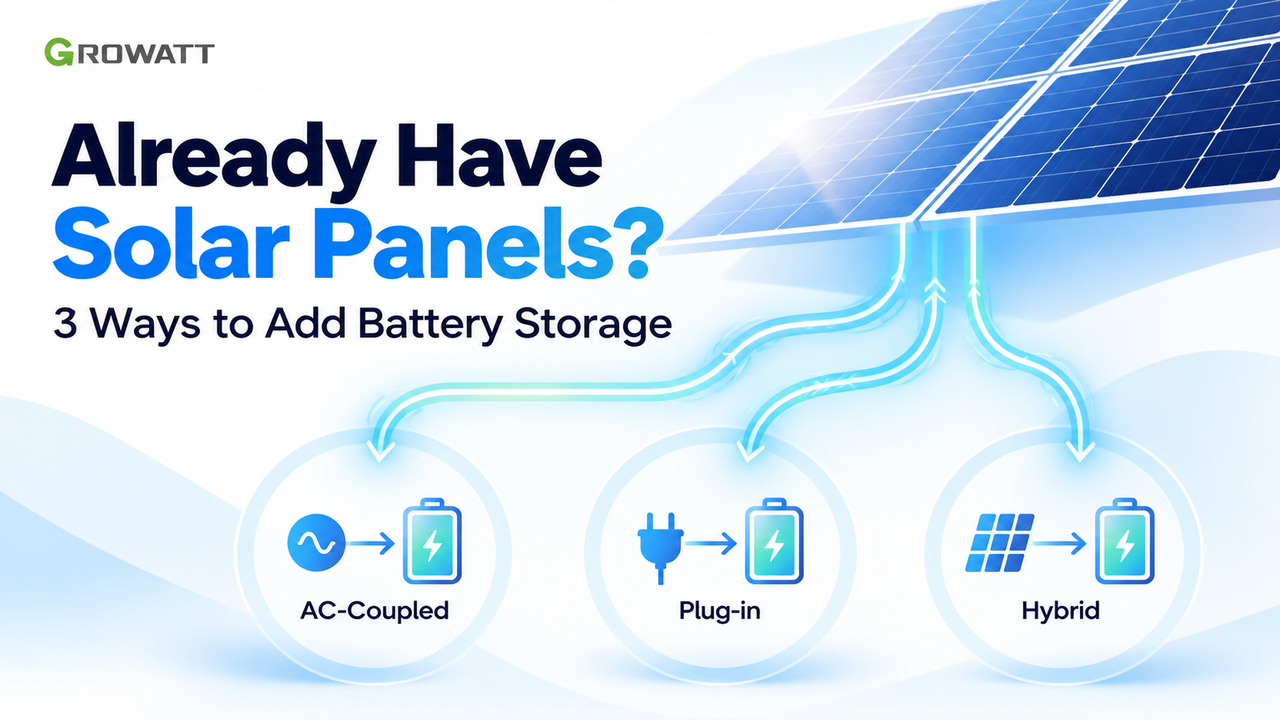
Existing PV owners can often add battery storage without replacing their inverter. Across Europe, plug-in batteries and AC-coupled retrofits offer options depending on compatibility, capacity, local rules and backup needs.
Yes. Many existing PV systems can add storage without replacing the solar inverter. The main options are:
Plug-in AC-coupled battery storage: Compact AC-side retrofit, subject to local electrical rules.
Professionally installed AC-coupled storage: Dedicated battery inverter and battery installed alongside the existing PV inverter.
Hybrid inverter and battery upgrade: Integrated solution that may require replacing the existing inverter.
The Netherlands will end its salderingsregeling (solar net-metering scheme) on 1 January 2027. Households will no longer offset exported electricity against purchases, although export compensation continues and charges may affect surplus solar value. Battery economics depend on installation costs, tariffs, export volumes and use. Check current Dutch government and ACM guidance.
A Balkonkraftwerk is a plug-in balcony PV system. Under Germany’s simplified framework, qualifying systems have an 800 W inverter AC output limit and a 2,000 W solar module capacity limit.
Battery storage may face additional registration, installation and grid-connection requirements. Check local rules; plug-in product design does not override regulations.
An AC-coupled battery connects to the home’s alternating-current (AC) side alongside the existing PV inverter, rather than directly to the panels’ DC circuit. Bidirectional conversion stores surplus solar for later use, and compatible metering can support automatic operation. AC-coupled systems can often work with other inverter brands, though metering, protection or wiring changes may be needed.
Option 1: Plug-In AC-Coupled Battery Storage — A Convenient Retrofit Approach
A plug-in AC-coupled battery adds storage on the AC side and may work alongside existing rooftop or balcony PV. Some systems support charging from surplus solar or lower-price electricity.
“Plug-in” does not mean every battery can connect to any socket. Circuit suitability, protection, installation method and permitted output must meet local rules.
Option 2: Professionally Installed AC-Coupled Battery — More Capacity and Installation Flexibility
A dedicated AC-coupled system connects a battery inverter and battery to the home’s AC infrastructure, often retaining the PV inverter. It may offer flexible capacity, power and backup. Installers should check electrical distribution, grid connection, phases, space and compatibility.
Option 3: Hybrid Inverter and Battery Upgrade — An Integrated Solar-Plus-Storage Solution
A hybrid upgrade replaces or supplements the existing inverter with a compatible model managing solar, battery charging, household use and grid interaction. In a typical DC-coupled setup, solar can charge the battery without first being converted to AC.
It may require inverter replacement, PV wiring changes and additional commissioning, so can suit homes planning a broader upgrade or whose inverter is nearing end of life.
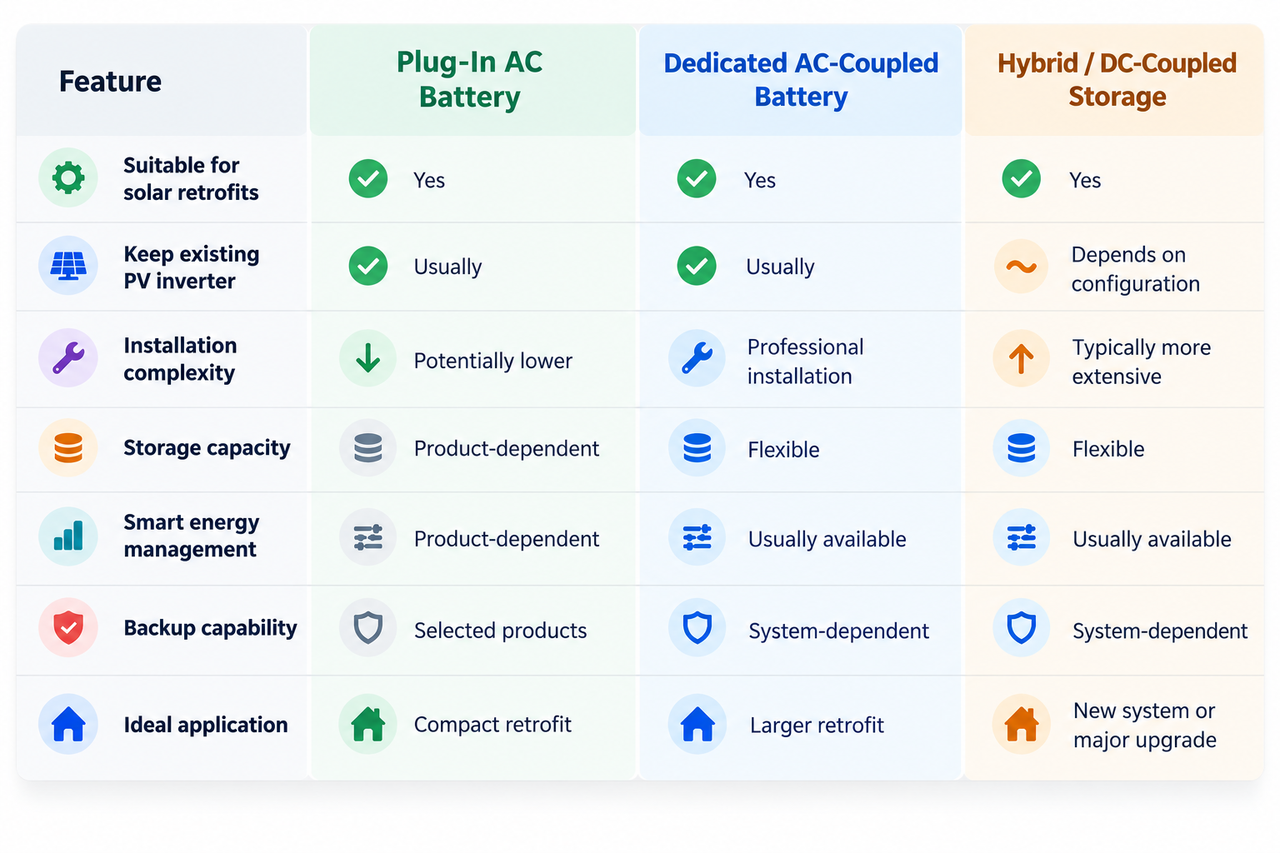
Plug-in batteries use a simpler connection; dedicated-circuit systems are installed for their load and protection needs. Permitted power depends on equipment, wiring and local rules. In the Netherlands, Milieu Centraal highlights circuit-overload risks and the NEN 1010 standard. Seek qualified advice for multiple batteries or higher power.
Growatt AURA 5000 is an AC-coupled battery storage solution for suitable rooftop solar and balcony installations. It combines lithium iron phosphate (LFP) storage, bidirectional AC conversion and intelligent energy management. Compatibility depends on configuration and local requirements.
Designed for Existing Solar Inverter Compatibility
AURA 5000 connects on the AC side of suitable solar installations and can often retain a functioning PV inverter. Confirm system, metering, monitoring and grid compatibility.
Flexible Battery Expansion From 5kWh to 20kWh
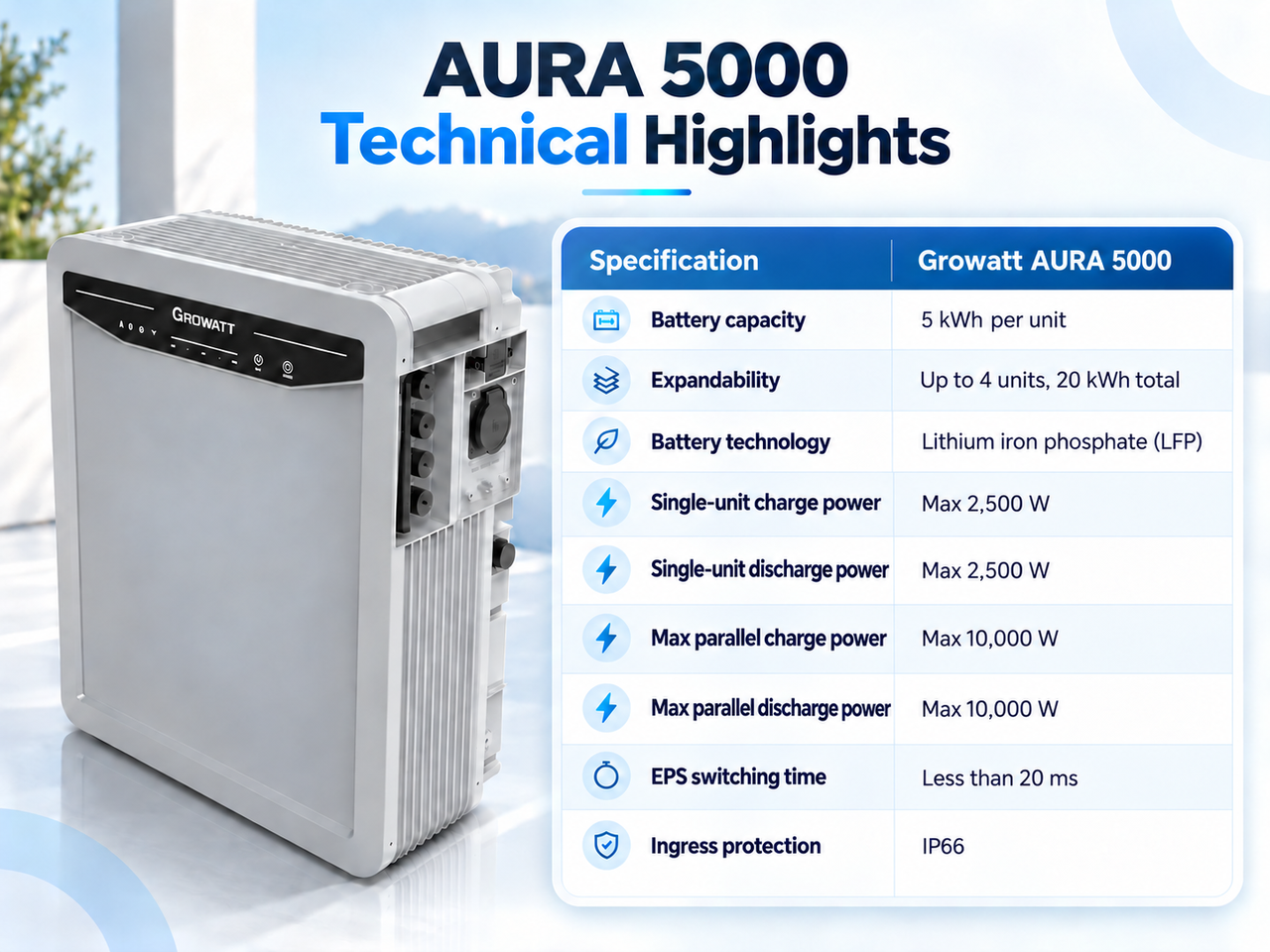
For households starting with a smaller energy storage requirement, AURA 5000 provides 5kWh of nominal battery capacity per unit. Its modular design supports expansion to a maximum of four parallel units, providing up to 20kWh of total nominal energy storage. In a single-unit configuration, AURA 5000 delivers a default charging power of 2,300W and discharging power of 800W. With Power+ enabled, both charging and discharging power can reach up to 2,500W. For parallel configurations, users can manually adjust the maximum charging and discharging power via the app. Under default settings, charging power can be set from 20W to 2,300W per unit, while discharging power can be adjusted from 0W to 800W per unit. With Power+ enabled, both charging and discharging power can be configured from 0W to 2,500W per unit, scaling with the number of connected units. This flexibility allows homeowners to adjust their energy storage capacity and power settings as household electricity demand changes.
Intelligent Energy Management for Dynamic Electricity Tariffs
AURA 5000 supports smart scheduling for household consumption and supported dynamic tariffs. With compatible metering, it can monitor energy flows and improve solar self-consumption. Supported devices include the SM-WLS01 reading head, SEM5-1 smart meter and selected third-party meters, subject to compatibility. Savings depend on tariffs, efficiency and usage.
Emergency Backup for Selected Essential Appliances
AURA 5000 supports an emergency power supply (EPS) for suitable loads, with up to 2,500 W output and switching time under 20 milliseconds in supported conditions. EPS supports selected essential devices, not automatic whole-home backup. Loads and duration depend on installation and remaining battery energy.
AURA 5000 Technical Highlights
Founded in 2011, Growatt provides solar PV inverters, storage and intelligent energy management. In 2026, it announced S&P Global Energy Tier 1 PV Inverter Supplier recognition, a top-three global hybrid inverter ranking by 2025 shipments, and EUPD Research Top Brand Storage Netherlands recognition. Check local support and warranty terms.
Choose battery size based on daily use, solar exports and electricity bought after sunset. Larger is not always better if surplus solar cannot charge it regularly. Compare energy capacity (kWh) with power output (kW); an installer can assess usage, usable capacity and charging opportunities.
Financial value depends on avoided grid purchases and higher self-consumption versus upfront cost, conversion losses and degradation. Milieu Centraal cautions that savings may not recover the full purchase cost.
Can I add battery storage without replacing my inverter?
Often, yes. A compatible AC-coupled battery can work alongside an existing inverter, subject to electrical, metering and local requirements.
Do plug-in batteries provide backup during blackouts?
Not all do. AURA 5000 supports EPS for selected loads when configured, not automatic whole-home backup.
Plug-in batteries, AC-coupled retrofits and hybrid upgrades can add storage without necessarily replacing an existing solar system. Batteries can store surplus solar and increase self-consumption.
The Netherlands’ 2027 net-metering change makes storage more relevant, but value depends on household use, equipment, local rules and costs. Explore Growatt AURA 5000 for suitable retrofits.
Already have solar panels? Explore Growatt AURA 5000.
Already have solar panels and considering battery storage?
Explore the Growatt AURA 5000 AC-Coupled Battery or visit www.growatt.com to discover more residential solar and energy storage solutions.
share


 Subscribe to our newsletter
Subscribe Now!
Subscribe
Insert your details below to receive information
*Enter Verification Code:


© Growatt New Energy All Rights Reserved


